The Stuff Of Nightmares
An investigation into how shared subconscious fears and anxieties manifest themselves through symbols and imagery of horror in art
Nightmares are defined as dreams that bring out exaggerated feelings of fear, terror, distress or anxiety. They often feel more vivid or intense than a bad dream and are differentiated from dreams because they can cause the sleeper to actually wake and experience intense feelings upon waking.
Sigmund Freud believed that dreams came from a person’s unconscious mind and represent his or her secret fears and desires. He believed that it is only when the conscious mind is silent do repressed emotions come to the surface and manifest themselves as nightmares. His theories imply that all dreams are significant and all have some underlying meaning. It is this meaning which I will explore within my essay. I will investigate how a possible shared subconscious of fears and anxieties might manifest itself through symbols and imagery of horror in art. I will explore this idea through the paintings of two artists from two very different contexts in history. I will compare and contrast three specific paintings from the artists Francis Bacon and Hieronymus Bosch whilst seeking to understand how the historical, social and political contexts in which they lived and worked influenced their paintings; exploring the meaning and significance of the imagery they chose to paint.
The first artist, Francis Bacon was born in Dublin on the 28th October 1909 and died on the 28th April 1992. Bacon was the second of five children born to English parents who had recently settled in Ireland. His childhood was spent at Cannycourt, County Kildare where he was blighted by asthma; something he would suffer from his entire life. After the outbreak of the First World War in 1914 his father took the family to London where he then joined the Ministry of War. At this time, Bacon would often run away from his school in Cheltenham. After his father rejected him following his admission of homosexuality Bacon was thrown out of his family home wearing only his mother’s clothes. Bacon later arrived in London in 1926 with a weekly allowance of £3 supplied by his mother following which he travelled to both Berlin and Paris in 1927 where he frequented the cities homosexual nightclubs. He then visited Picasso’s exhibition at the Gallery Paul Rosenberg in 1927 where he was greatly influenced by his work; this inspired Bacon to begin drawing and painting while attending some of the free Academies that were available. He returned to London the following year where he established himself at Queensbury Mews West in South Kensington. Bacon also worked as an interior designer in the style of Eileen Gray (later displaying his work in 1929) where his work was featured in a studio before later sharing a second studio with the painters Roy de Maistre and Jean Shepeard.
Essentially a figurative painter, Bacon’s subjects included portraits of Popes, self-portraits, crucifixions and portraits of friends which he manipulated within his work in order to form abstract figures strategically placed within geometrical structures. He claimed that his work was created with the intent to render the “brutality of fact.” Bacon was incredibly well known for his unsettling imagery that focused on the human form.
Bacon often worked within triptych and diptych formats, focusing on one single subject for extended periods of time; claiming that he visualised images “in series” one after the other. Bacon’s work can often be identified sequences inspired by one singular motif; some of which include the 1930s Picasso bio-morphs and Furies and the 1950s “screaming popes.”
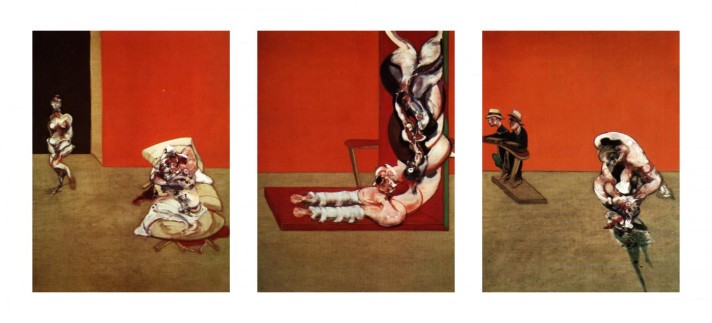
One of Bacons most famous pieces of work was entitled Crucifixion 1965; a triptych made up of three panels depicting three different forms of violent death. The triptych was the third within a series of paintings that Bacon had painted relating to the crucifixion. For Bacon the crucifixion was “a magnificent armature on which you can work about your own feelings and sensations…you are working on all sorts of very private feelings about behaviour and the way life is.” His series of paintings named the Crucifixion 1965, closely followed the 1962 triptych in terms of its mood colour and form. It continues Bacon’s imagery of the slaughterhouse which he had been exploring earlier within his work. The three images depict different butchered victims, hanging upside down and splayed across the floor. Bacon use of warm bold colours evoked feelings of uneasiness and violence in his audience. Although the crucifixion is similar to his other work on the slaughterhouse, in which the focus was conveying a sense of urgency and struggle, the crucifixion depicts defeat. The dull lifeless orange background Bacon used further emphasised the violent atmosphere that he was trying to create. In addition to using a variety of warm tones, he blended them together in order to resemble the dismembered corpses of the subjects within his paintings. Bacon deliberately chose to smear reds, oranges and blues together to create abstract representations of corpses. Their lack of detail and mangled form create a sense of uneasiness because they only share a few aspects with the human form such as skin tone and shape; whilst other aspects seem horror-like and dismembered like pieces of meat being messily held together amongst geometric shapes and parallel lines. It could be argued that the violent imagery within Bacon’s work could have been influenced by his difficult childhood: his exposure to war and violence at such a young age when his father joined the ministry of war in London after the First World War and his father’s rejection of his homosexuality whilst throwing him out of his house in his mother’s clothes.
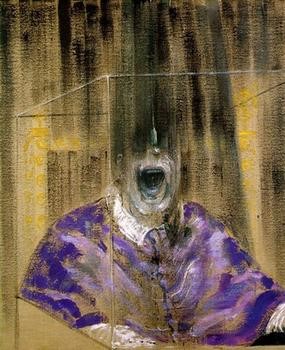
Another famous painting by Bacon is entitled Head VI. It is an oil-on-canvas painting and shows an alternative view of one of his earlier Pope paintings entitled Innocent X (one of many developed over a twenty-year period.) In contrast to the painting Crucifixion 1965 Bacon uses cooler tones such as yellows and purples. He also places his subject within a glass box defined by blue lines adding geometric shapes just like in his earlier pieces. Within this painting Bacon applies forceful textured brush strokes around the face of the subject whilst only allowing the mouth to be visible. The textures create a chaotic atmosphere once placed on the black backdrop giving his painting a sense of uneasiness. In addition, a part of the figures identity is hidden. Furthermore, the layered texture upon the curtain like backdrop and the glass box surrounding the subject gives the effect of a man being confined and suffocated by his surroundings and is reminiscent of execution by the electric chair
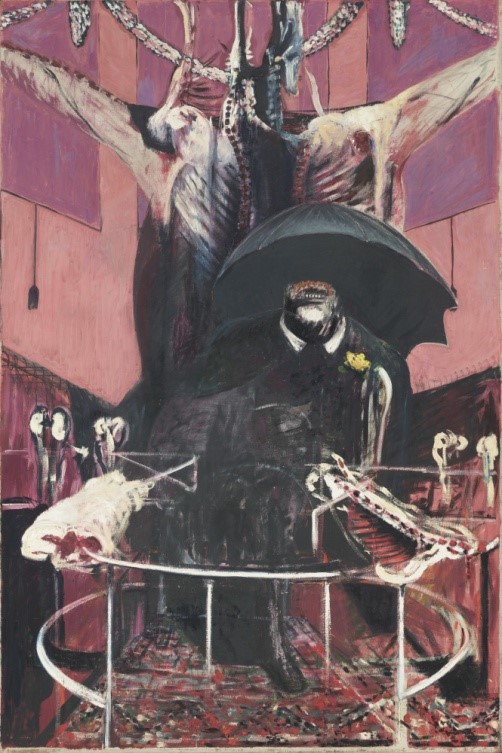
One of Bacon’s most influential paintings is 1946 – painted shortly after the end World War II; the image is a damning painting which makes reference to Neville Chamberlain who was a pre-war British prime minister. The umbrella partially covers the man’s face: an umbrella which Chamberlain was known to carry around. The dark suit was the uniform of the British politician at the time which was accented by the use of the yellow boutonniere: an aspect which contrasts with his toothy grin and suggested brutality accented by the cow carcasses suspended in a cruciform around him. This piece is a continuation of a recurring motif which had fascinated Bacon since his childhood; the slaughter house. The dark tones and dull, earthy, warm colours which can be identified throughout the painting in combination with the Prussian blue aspects give a sense of lifelessness yet hostility to his work. These feelings of hostility could have been influenced by Bacons experiences as a child at the hands of his father; by demonising men within his work it suggests that his trauma could have distorted and corrupted his view of any male figure who held violent powers and represents a manifestation of the mistreatment by his father. Chamberlain held the power to effect war as the Prime Minister and by depicting him as this dark figure surrounded by rotting carcasses it illustrates Bacon’s negative feelings towards med with power – his interpretation could suggest that he feels victimised by them.
The second artist, Hieronymus Bosch was born in 1450 and died on the 9th August 1516. He was a Dutch painter from Brabant and is one of the earliest representatives of the Netherlandish painting school. Bosch’s work illustrates religious concepts and narratives; working mainly with oil on oak wood. Throughout his life Bosch produced at least 16 different triptychs, five of which are in fragments, whilst the other eight are fully intact. His work is mainly organised into three different periods of his life, his early works (1470-1485), his middle period (1485-1500) and his later period of works (1500 until his passing in 1516). Most of Bosch’s recovered work was mainly painted during the later period of his life whilst the majority of the work from early period of his life is studied in terms of his workshop activity in which he taught pupils and influenced their work.
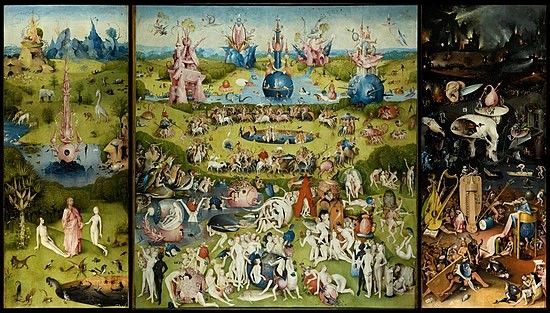
Bosch’s most influential paintings is his Garden of Earthly Delights; a triptych oil painting on oak panel painted between the years 1490-1510. It is made up of three separate illustrations including intricate designs. There have been many different interpretations of this painting, ranging from the admonition of indulgence and a warning of life’s temptations. The symbolism within the central panel has led to a wide range of interpretations over the centuries with some believing it is a moral warning or perhaps a panorama of paradise lost. Themes of heaven and hell continue throughout Bosch’s work and can be seen in another one of his paintings entitled Death and the Miser.
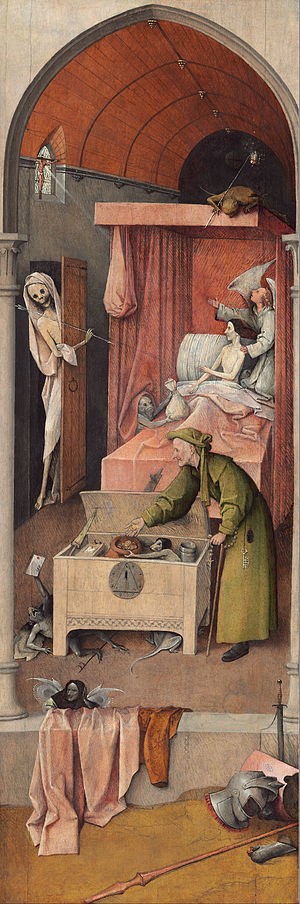
The Death and the Miser is a Northern renaissance painting produced between the years 1490-1516. The piece was originally part of a triptych however, the centre piece is missing. The painting is a memento mori meaning its purpose it to remind the viewer of the inevitability of death, the sins of greed and the futility of materialism and wealth; death stands at the door ready to greet his next soul. There is still no certainty around the objects in the foreground and the dull warm tones give the painting a sense of lifelessness which has similarities with the work of Bacon. Bosch’s paintings were inspired by religious texts of the historical time in which he worked which heavily influenced Christians way of life at that period of time in history. The majority of his paintings to date are currently being held in Washington D.C at the National Gallery of Art.
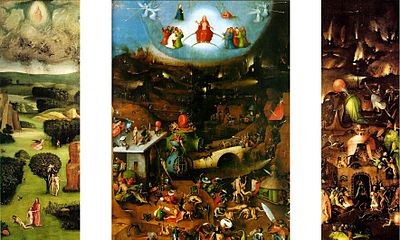
Another influential painting by Bosch is entitled The Last Judgement another triptych created just after 1482. Whilst the outside shutters are painted in grisaille the inside shutters are painted using oil paints. On the left panel is shown the Garden of Eden where you can see God is shown seated in heaven with the angels scattered all around – cast out of heaven – turned into insects. At the bottom of the panel can be seen God creating Eve from the rib of Adam and in the mid panel we can see Eve being tempted by the Serpent. The panel is further illustrated with many other little intricacies which depict the judgement of souls with Jesus responsible for the of Saints. The Last Judgement is a continuation of Bosch’s exploration of heaven and hell whilst maintaining his use of warm, dull colours to create an almost lifeless look to his work.
To conclude, it can be argued that there are many similar themes evident within the work of both Bosch and Bacon. Although differences exist in terms of painting style and techniques themes related to sinful humanity and its consequences, concepts of heaven and hell and moral and spiritual truths and dilemmas are explored in both their work. The artists use of warm, dull, lifeless colours such as Prussian blues create darker tones and shadows increasing a sense of uneasiness and fear for the audience. Both Bacon and Bosch portray violent and morbid imagery within their work. Bosch frequently included images of humans and demonic creatures being tortured in scenes set in heaven and hell, whilst Bacon painted morbid imagery of mangled corpses and abstract creatures in surreal geometric settings. In contrast, Bosch painted scenes from religious texts whilst Bacon painted imagery heavily influenced by his traumatic childhood and his issues with self-identity as a homosexual. However, it could be argued that much of Bacon’s work has religious undertones and symbolic meaning. Bacon was an artist working in a more recent historical and social period and as such had more freedom of expression to paint than Bosch who was constricted by the role of an artist who was commissioned to paint and work in an historical period in which religious concepts of heaven and hell were paramount; his role as an artist was to illustrate the predominant religious theology of that period of time. The violence portrayed within his work is almost like fantasy to the modern eye whereas, in contrast Bacon’s work, the morbid imagery, mangled bodies and the sense of urgency and struggle can be more easily identified with making his work seem somewhat more real and impactful. However, despite the differences in terms of time periods in which they worked, the historical and social contextual influences they painted within, it can be argued that their imagery depicts a possible shared subconscious of fears and anxieties which manifest themselves through similar imagery and symbols of horror that we recognise more readily today in their paintings.
 Ellen Louise McDermott